

Firebird signs Kazakhstan deal to expand AI infrastructure
Thu, 29th Oct 2026 (Today)
Firebird has signed an investment agreement with the government of Kazakhstan to expand AI infrastructure in the country. The deal was announced during a visit to Astana by NVIDIA Founder and Chief Executive Officer Jensen Huang.
Under the agreement, Firebird is expanding beyond its first AI factory in Armenia into Kazakhstan, where it has secured a US export licence for 45,000 NVIDIA Grace Blackwell GPUs. The first phase, being built with Kazakhtelecom at Data Centre Valley, is targeting a commercial launch in the third quarter of 2027.
A planned second phase would take Firebird's potential AI infrastructure capacity in Kazakhstan to about 500 megawatts. It also plans to establish Firebird Labs Kazakhstan to support local startups, research and talent development through funding, access to computing resources and research partnerships.
Kazakhtelecom, the country's largest telecommunications company, has already deployed 400 NVIDIA H200 and 480 NVIDIA B300 GPUs in Astana and Almaty. It also plans to deploy more than 1,000 GPUs in Data Centre Valley, along with more than 1,000 NVIDIA Vera Rubin GPUs in the Ekibastuz region.
Broader push
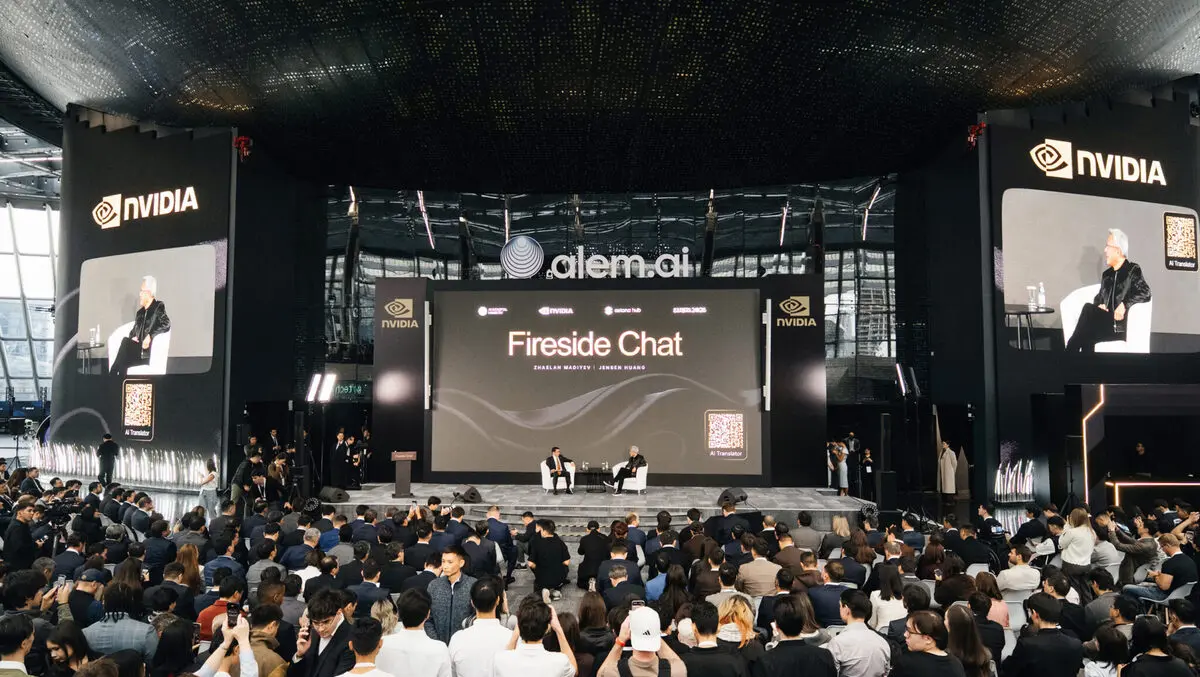
The infrastructure build-out comes as Kazakhstan pushes to develop domestic AI models and applications. During a public discussion at the Alem.AI centre in Astana, Deputy Prime Minister Zhaslan Madiyev said the country wants AI systems that reflect its language and culture.
"We want AI that understands and speaks Kazakh and captures cultural contexts and cultural specifics," Madiyev said.
Huang said local data would be central to that effort and argued that Kazakhstan could use its energy resources to support AI production.
"Instead of just exporting energy, in the future, you could transform energy into intelligence and export intelligence," Huang said.
He also stressed the importance of retaining control over national datasets.
"Your country's data is your natural resource. It belongs to you," Huang said.
The discussion also covered the use of AI in mining, mineral processing, agriculture, transport and logistics. Madiyev raised the prospect of Kazakhstan becoming a hub for training models for robots and other physical systems, an idea Huang welcomed.
"If you have ambition, and I believe you do, AI will lift your nation," Huang said. "AI will lift your people."
Startup activity
The Astana event also brought news that NVIDIA is investing in Higgsfield AI, a startup founded in Kazakhstan. Huang praised the company's founders during the public session.
"The first thing and the last thing is you invest in people, not companies," Huang said.
Higgsfield is expanding its AI infrastructure with NVIDIA Vera Rubin through cloud service providers as demand grows for its generative media products. The move adds to signs that local AI companies are increasing their own computing capacity as access to hardware improves.
Other companies are also testing commercial uses for the technology in the country. inDrive and Pony.ai are working together to explore robotaxi services in Kazakhstan, with Astana identified as the first city under consideration for deployment.
The two companies will assess the feasibility of bringing Pony.ai's seventh-generation robotaxis to the inDrive app. The effort is supported by NVIDIA AI infrastructure and built on the NVIDIA Hyperion sensor and compute platform with the NVIDIA Halos safety system.
National focus
Kazakhstan's government has been presenting AI as a national development priority, linking it to energy, digital infrastructure and industrial modernisation. The discussions in Astana reflected that wider agenda, with ministers, telecom operators, infrastructure investors and startups all featuring in the same set of announcements.
Huang also addressed AI security and education during the public discussion. He said the technology should be developed and deployed responsibly and pointed to NVIDIA's OpenShell as a way to contain AI agents by limiting access to files and tools while monitoring activity.
For younger people entering the sector, he said learning the underlying principles of AI mattered more than simply learning how to use the tools.
"I envy being 18 years old today... because the world is changing so rapidly, and there's a complete reset because of technology," Huang said.
The visit also carried symbolic importance. President Kassym-Jomart Tokayev presented Huang with the Order of Dostyk, First Class, in recognition of his contribution to the development of artificial intelligence in Kazakhstan.
Later in the day, officials from the International Judo Federation presented him with an honorary black belt in judo, describing it as a gesture of thanks for his support for Kazakhstan's AI ambitions and for leadership aligned with the discipline's values.
For Firebird, the investment marks a rapid expansion from an initial concept into a major regional project.
"What began as a seed of an idea 180 days ago has grown into a major investment in Kazakhstan's AI future," said Razmig Hovaghimian, Co-Founder and Chief Executive Officer of Firebird. "President Tokayev's vision gave us the confidence to think bigger about what we can build together. With Jensen Huang here today, that ambition feels more tangible than ever. We're building the infrastructure for Kazakhstan's talent and ideas to reach the world."