

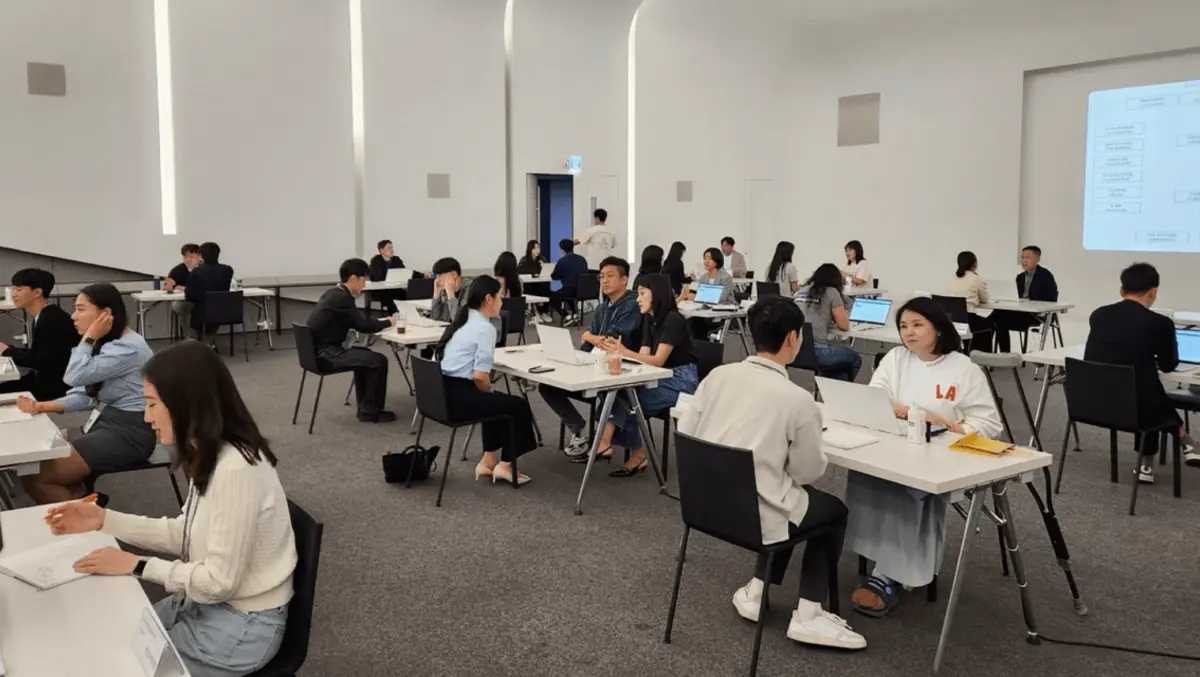
Hyundai Card broadens digital talent beyond tech majors
Thu, 18th Jun 2026%201.webp)
Hyundai Card is broadening its definition of digital talent beyond IT majors and software developers, linking that approach to its wider shift toward a technology-led financial business.
An internal analysis by the South Korean card issuer found that 33% of employees in its Digital Division studied non-STEM subjects, including the humanities and design. About half had previously worked outside traditional digital or IT fields, with backgrounds in retail, education, gaming, consulting and healthcare.
The figures show how Hyundai Card is structuring its workforce as financial groups place greater emphasis on data, artificial intelligence and digital systems. Rather than focusing only on specialist engineering hires, it is combining technical staff with employees whose experience lies in planning, design, customer insight and commercial functions.
That approach reflects a broader business debate over what constitutes digital talent. As companies apply AI and data more directly to product design, marketing, customer service and decision-making, they are increasingly seeking staff who can connect technical tools to business problems.
Hyundai Card also operates a dedicated data science team that works closely with its Private Label Credit Card (PLCC) business.
The aim is to link data work more closely to products, marketing, customer experience and commercial performance. In practice, data teams work alongside the business units responsible for partner card programmes and related services.
PLCC focus
The PLCC business has become central to Hyundai Card's strategy in Korea. It accounts for 78% of PLCC issuance in the country, giving the company a leading position in that market segment.
It has also developed Domain Cosmos, a data alliance involving its PLCC partners. Under the model, data collaboration occurs not only between Hyundai Card and individual partners but also among the partners themselves.
That structure increases the need for employees who can interpret data in a commercial context, not just process it. Understanding a partner's industry, tracking shifts in customer behaviour and applying findings to marketing, products, risk management and customer experience requires a mix of technical and non-technical skills.
The comments come as employers reassess the balance between specialist expertise and broader workplace skills in the AI era. Hyundai Card pointed to rising demand not only for AI and big data expertise, but also for qualities such as creative thinking, resilience, flexibility and curiosity.
For financial groups, the shift has practical consequences. Credit card issuers and other consumer finance businesses increasingly rely on data analysis not only for underwriting and fraud detection, but also for product design, loyalty schemes and personalised customer offers.
In that context, staff from outside pure technology fields can play a larger role in shaping digital projects. A humanities background may support consumer and social analysis, while design experience can help simplify financial products and digital interfaces.
Experience in sectors such as retail, gaming, or healthcare can also offer perspectives that differ from conventional banking or card-industry thinking. That can be valuable when companies are developing new services or working more closely with consumer brands.
Tech export
Hyundai Card's workforce strategy is part of a longer digital transformation effort. The company has described data and AI as core elements of its business since declaring itself "Digital Hyundai Card" in 2015.
One visible outcome of that push was Hyundai Card's export of its AI platform, Universe, to Sumitomo Mitsui Card Company in Japan. It said the deal marked the first export by a Korean financial company of independently developed AI software.
The transaction provided an example of how Hyundai Card's internal technology development could be commercialised beyond its domestic card business. It also underscored how competition in consumer finance is expanding beyond traditional lending and payments to ownership of software, data tools and related intellectual property.
Hyundai Card attributes part of that progress to the way it has organised its people and functions. It has been argued that digital transformation depends less on a narrow set of coding roles than on building teams that can navigate the gap between technical language and business decisions.
A Hyundai Card official said, "Hyundai Card does not define digital talent by a specific major or job function. The company sees digital talent as people who understand technology, data and business together. The fact that people from diverse backgrounds have come together and worked as a single organisation has been the foundation of Hyundai Card's transformation into a tech-driven company."