

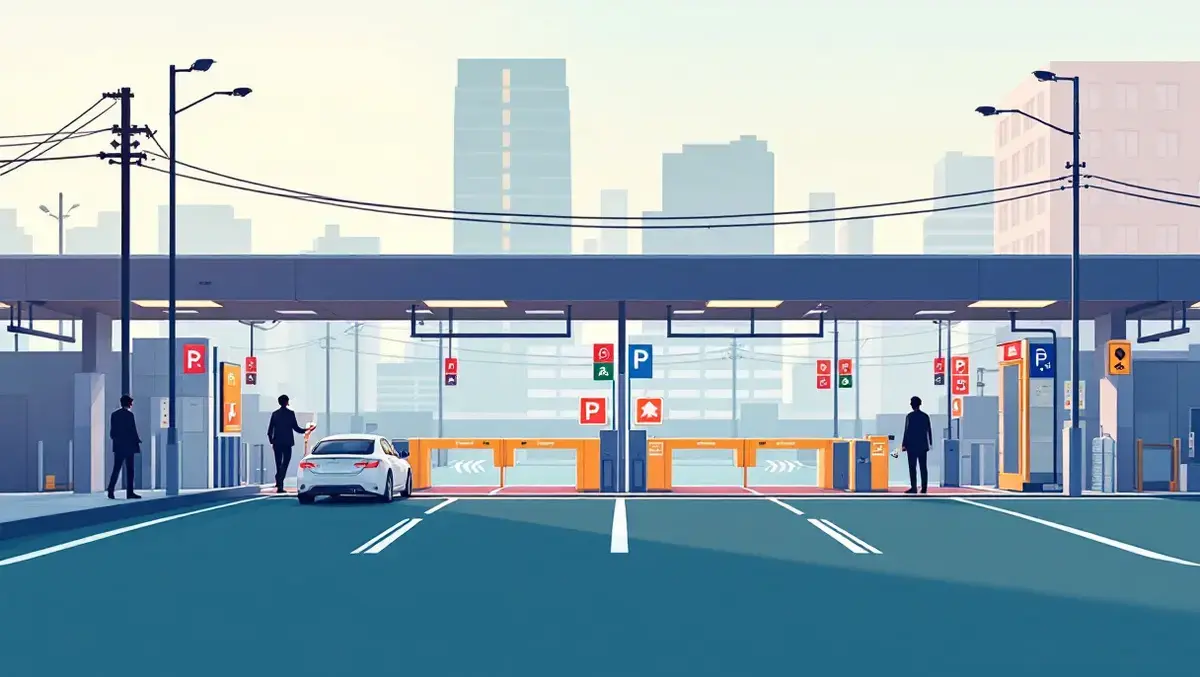
NEC & UrbanChain test parking charges when drivers leave
Fri, 7th Aug 2026
NEC and UrbanChain will launch a demonstration of a next-generation parking service in Japan.
The trial will test a system that starts parking charges when vehicle occupants leave their car.
Beginning in September, the month-long demonstration will take place at surface car parks in Fukuoka Prefecture. It will combine UrbanChain's Parking OS, an automated payment module within its wider UrbanOS platform, with NEC image-recognition technology that detects when people exit a vehicle.
The project addresses a long-standing problem for parking operators and drivers: parking fees often start when a vehicle enters a site, rather than when the driver has parked and left the car. As a result, motorists can be charged while searching for a space, dropping off passengers or turning around after deciding not to park.
Safety is another focus. The companies cited growing concern over incidents involving drivers who become unwell while still inside their vehicles. The system is intended to identify vehicles where no occupant has been confirmed leaving for an extended period, allowing operators to review whether intervention may be needed.
NEC has been working to digitalise parking facilities through systems for mechanical car parks, including tools that use image recognition to detect people and vehicles and monitor pedestrian movement. UrbanChain has been developing digital systems for parking operations through its Parking OS platform.
The two companies began exploring a combined service model earlier this year. The approach under review uses the moment a driver exits the vehicle as the starting point for billing, rather than when a car enters the facility.
Technical tests
The demonstration is designed to assess whether that model can work in day-to-day operations. Technically, the companies will test how effectively the image-recognition system can detect when occupants leave a vehicle and how well that function integrates with Parking OS.
They will also examine how reliably the system can flag vehicles where no occupant exit has been recorded for a prolonged period. Another test will assess whether occupant exit counts can be measured accurately enough to support analysis of customer visits at commercial facilities.
That suggests the trial has a wider commercial angle beyond parking payments. If operators can establish how many people leave vehicles and enter nearby sites, landlords and retailers could use that information to better understand visitor flows at shopping centres and other destinations.
Business case
The business assessment will focus on what would be needed to run the system in practice. That includes determining how many cameras are required, where they should be installed and whether the safety functions offer enough benefit to justify broader deployment.
The companies will also evaluate the billing model itself. Charging from the point when a driver exits a vehicle could appeal to motorists who view current arrangements as unfair, but operators will need to judge whether the system is reliable enough to support revenue collection without creating disputes.
The trial also reflects a broader push to digitise urban infrastructure and mobility services in Japan. Parking has often remained less advanced than other parts of transport, particularly at open-air surface sites where staffing is limited and drivers expect quick entry and exit.
By linking computer vision with payment software, NEC and UrbanChain are seeking to move beyond conventional ticketing or barrier-based systems. The approach could reduce friction for users while creating a more detailed record of what happens after a vehicle enters a site.
Wider plans
While the immediate focus is on surface car parks, the companies are also examining whether the model could be applied more widely across the parking sector. NEC already works on mechanical parking systems used in multi-level structures, which could provide another route for adoption if the trial produces workable results.
They are also studying potential data services linked to commercial property. These could include monitoring how many occupants leave vehicles and using those counts to analyse visit trends at surrounding facilities.
Such uses would place parking data in a broader retail and property context, where landlords are looking for more precise measures of footfall and customer behaviour. For parking operators, that may open up a business case beyond fee collection alone.
The demonstration in Fukuoka Prefecture will therefore serve two purposes: testing whether the technology can accurately identify occupant exits and determining whether a charging model based on that moment can work commercially in real-world parking operations.
The trial will assess the service model from both technical and business perspectives, including camera placement, the value of safety functions and the accuracy of occupant exit counts used in customer visit analysis.