

.webp)
Switzerland has retained the top global ranking for the share of venture capital invested in deep tech, according to the Swiss Deep Tech Report 2026. The report also places the country first in Europe for deep tech investment per capita.
It found that 63% of Swiss venture capital goes to deep tech, ahead of China at 56% and the United States at 54%. Switzerland invests USD $1,470 per person in the sector, putting it ahead of every other European market and among the top three worldwide.
Deep tech funding in Switzerland reached a record USD $2.6 billion in 2025, roughly five times the level in 2015. The increase reflects a maturing market, with more companies raising larger rounds while remaining in the country as they expand.
The data also points to a strong role for the country's research institutions. ETH Zurich and EPFL Lausanne were ranked Europe's leading universities for new deep tech spinouts, and the pipeline of companies emerging from them is now moving into seed and Series A stages.
Shift in focus
Artificial intelligence and machine learning now account for one in four newly founded Swiss deep tech companies, more than double their previous share of 11%. Switzerland also has the highest density of AI researchers in the world, at twice the level of the UK and the US.
Robotics was another growth area. Since 2020, Switzerland has created 3.5 times more venture-backed robotics startups per capita than the US and five times more than the UK.
In computing-related fields, 2026 was already a record funding year. Switzerland also produces seven times more patents per capita than the European average in this area, supported by domestic strengths in microelectronics and precision sensors.
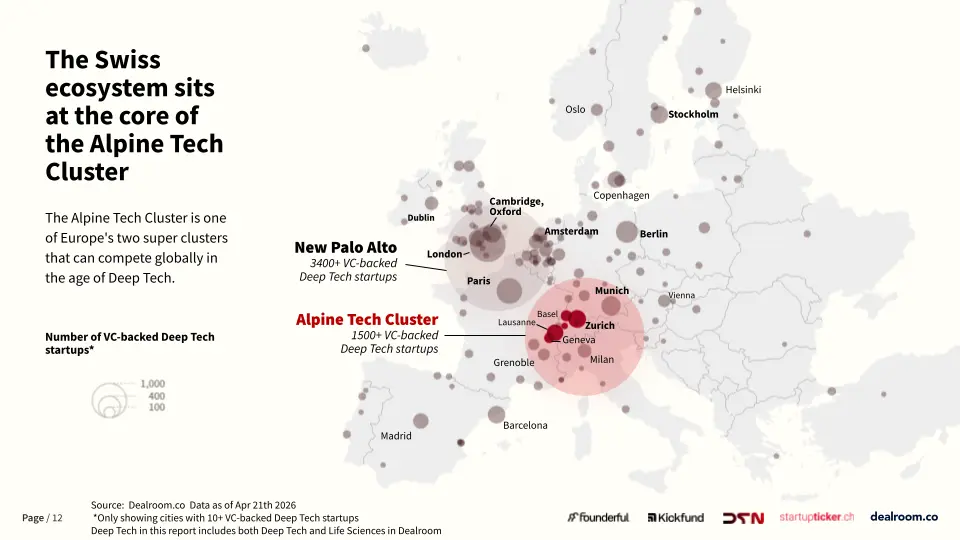
The wider Alpine Tech Cluster, anchored in Switzerland, was identified as one of Europe's two deep tech superclusters. The region is home to more than 1,500 venture-backed deep tech startups, underlining Switzerland's role as a hub for science-led company formation.
Investor mix
Foreign investors play an outsized role in later-stage rounds. The report found that 88% of Swiss deep tech funding in rounds of USD $100 million and above comes from overseas investors, compared with 75% across Europe, while domestic capital accounts for 12% at that stage.
That pattern suggests international funds are increasingly willing to back Swiss companies as they scale, even as the local investor base remains stronger at earlier stages. The report argued that this leaves room for more early entrants in a market that ranks highly on both investment intensity and company creation.
One of the report's co-authors said investor interest had shifted over the past year. Global funds were now approaching Switzerland without sustained outreach from the local ecosystem.
"The energy and talent dynamism reminded me of what we saw in Israel and the UK in the early 2000s," said Saul Klein, founding partner at LocalGlobe.
Jean-Philippe Fricker of Cerebras Systems linked that momentum to the universities feeding the sector. "For the first time, the companies spinning out of ETH and EPFL are staying, scaling and attracting serious capital," Fricker said.
The report's authors also said the current crop of startups could drive another period of growth. Many of the companies now entering seed and Series A stages are part of the largest cohort of Swiss deep tech ventures yet produced, a point in the funding cycle when valuations and capital raised tend to rise sharply.
Anna Fontcuberta i Morral, president of EPFL, said that pipeline was visible inside the academic system. "At EPFL we see it every day: the discoveries made in our laboratories become the deep tech companies of tomorrow," she said.
Wanja Humanes, partner at Kickfund, highlighted the country's funding model and the limited role of direct state venture backing compared with larger European markets. "We built one of the world's most deep tech-focused economies without a franc of public venture capital. In Germany, France and the UK, much of the late-stage money is state-backed through Bpifrance, British Patient Capital or the German Future Fund. In Switzerland that barely exists, and yet the world's best investors now come here on their own initiative, with some setting up shop. No public money had to write the cheque to make this real," Humanes said.