

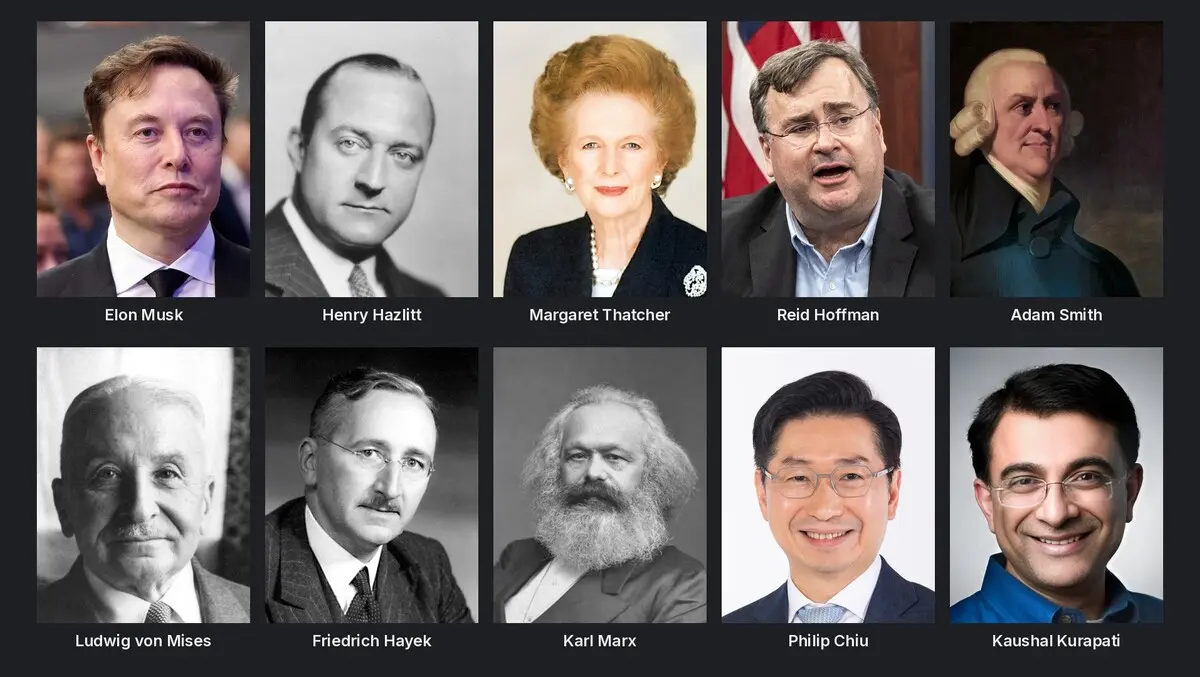

Socialism's fatal flaw has never been a shortage of good intentions. It is human nature. Planners can't know enough, few of us work as hard for the collective as we do for ourselves, and, as Margaret Thatcher told Thames TV in 1976, socialist governments "always run out of other people's money."
So here is a heretical thought. What if socialist-leaning technologists (LinkedIn co-founder and Superagency author Reid Hoffman is the sort I have in mind, though he would no doubt describe himself differently) built artificial intelligence that delivers socialism's promises without the flaw? Take the human factor out of socialism and you also take out its consistently acknowledged weakness.
I write this as an avowed, if entirely unsuccessful, pracitioner of capitalism and free market economies. I've always regarded socialists with suspicion, falling somewhere on a continuum from the hopelessly idealistic to the aggressively ignorant.
Why the market worked
Henry Hazlitt's Economics in One Lesson (1946) boiled the discipline down to one idea: "The art of economics consists in looking not merely at the immediate but at the longer effects of any act or policy; it consists in tracing the consequences of that policy not merely for one group but for all groups."
Apply it to last century's planned economies and the longer effects are rarely, nay, never pretty.
My own perspective is simpler. Capitalism has been the only system that consistently works because, to prosper, a man had to serve his fellow man. It is therefore inherently moral, unlike the inherently immoral socialism which seeks to redistribute the effort of others.
There was no alternative. Adam Smith said it better in 1776, explaining what he meant by 'enlightened self interest': "It is not from the benevolence of the butcher, the brewer, or the baker, that we expect our dinner, but from their regard to their own interest." Planners, as Ludwig von Mises (1920) and Friedrich Hayek (1945) argued, lack the prices and scattered knowledge needed to allocate anything sensibly.
Hayek and von Mises were on to it. Something like 'price gouging' or 'surge pricing', serves as a price signal that effectively and automatically manages supply and demand. By contrast, 'rent controls' or 'minimum wage laws' do the opposite, interfering with price signals, distorting markets, and hurting the very people they nominally seek to help.
But what happens when the butcher, the brewer and the baker are robots, and the planner is a superintelligence?
Scarcity, meet abundance
Technology's long game is turning scarcity into abundance. Take surgery. Interviewed for TechDay this month, Professor Philip Chiu, Dean of the Faculty of Medicine at The Chinese University of Hong Kong, said robotic surgery still accounts for perhaps 5% of operations worldwide, but lower-cost systems from multiple makers are arriving. The aim, he said, "is to convert surgery from the analogue to a digital scale." Shorter hospital stays help, too: "One bed can cater [for] two patients instead of one. Double the productivity."
At Oracle AI World in Las Vegas last week, Oracle Fusion AI's Kaushal Kurapati told a media roundtable that "Some of this honestly couldn't even have been possible about eight, nine months ago." He added: "I've been working in AI my whole career, but still, I've never seen this pace of change."
Anyone who has switched to an electric car knows the pattern: almost no learning curve, and the almost inescapable observation that a petrol car feels positively primitive by contrast.
Which is why the avowed socialist and communist Elon Musk might have a point. "I think it's actually going to be universal high income, where anyone can have any goods or services that they want," he said at the Saudi-US Investment Forum in May 2025. Six months later he went further: "at some point currency becomes irrelevant."
Billionaires are, I suspect, unlikely to be motivated by money itself; past a certain number, it's a scorecard. Apocryphally, I recall Mel Gibson saying that past a certain number, more money means absolutely nothing. You can't buy a faster car or a bigger jet.
Through his communist activities, Musk as created hundreds of thousands of jobs, pioneered multiple new industries, and added almost incalculable value to human society. Ever seen his yacht? He doesn't have one.
Musk told the US National Governors Association in 2017 he had no motivation for accumulating assets "except to be able to make the biggest contribution I can to making life multi-planetary." In 2021 he posted that he was "accumulating resources to help make life multiplanetary & extend the light of consciousness to the stars."
Money is a means of exchange for goods and services, and exchange is only necessary when goods and services are scarce. If food, medicine, surgery and mowed lawns approach free, does money itself become superfluous?
Ironically, that was the notoriously accumulative capitalist Karl Marx's endgame. In his Critique of the Gotha Programme (1875), he reserved "From each according to his ability, to each according to his needs" for a higher phase of communism, after the 'productive forces' had grown enormously. This refrain puts a certain level of fear into any productive person, as detailed by Ayn Rand, and a glint in the eye of the non-productive suffering the indignity of relative deprivation.
Humans never got Marx there, thanks to their cupidity, avarice, and (one presumes, unenlightened) self-interest. Might machines?
Are we the baddies?
Some of the loudest resistance to AI advancement comes from the left, potentially reinforcing the aggressive ignorance end of the continuum. In the USA, Virginia senator Bernie Sanders, who through a long career in politics has directly lifted exactly one person out of poverty, has long railed against 'oligarchs' with Musk as a particular target, though Jeff Bezos, Mark Zuckerberg and Larry Ellison are regularly the target of his ire. Sanders worries that these and other leaders are pushing AI and robotics because it will "increase their wealth and power exponentially", and that it will wipe out tens of millions of jobs; suffice to say, Sanders posts his commentary freely, relying on the products and services created and delivered by the very men he despises.
And their data centres. For some, to me, bizarre reason, data centres are a modern bete noir, the beast under your bed. Together with Alexandria Occasio Cortez, Sanders recently announced the AI Data Center Moratorium Act, seeking a pause on new AI data centre construction and upgrades. Declaimed Cortez: "Congress has a moral obligation to stand with the American people and stop the expansion of these data centers until we have a framework to adequately address the existential harm AI poses to our society. We must choose humanity over profit."
The 'oligarchs' chose humanity over profit when they produced the goods and services we all willingly pay for and use daily.
Echoes of this madness reverberate across the world. In July, New Zealand's Green Party called for a one-year pause on consenting new AI data centres here; its 'Safe, sovereign AI' plan now wants an open-ended pause until regulations are in place.
The Greens are hardly alone among the ill-informed do-gooders fighting data centres and AI.
Take water. Lawrence Berkeley National Labouratory estimates US data centres consumed about 66 billion litres directly in 2023 (roughly 800 billion more went on generating their electricity). US golf facilities, by the industry's own survey, applied about 1.69 million acre-feet in 2020, or around two trillion litres. Nobody is marching on the 18th green. And one could quite legitimately ask if American data centres are creating more societal value, or if the golf courses lead the way; as a capitalist, I welcome both as essential to our modern way of life.
While there is, even in the most seasoned of hands, a duality of fear and excitement about the runaway development of AI as it ushers us truly into an age of the unknown and unpredictable, fear is a poor guide to what a technology delivers. Bear in mind that the physics behind the atomic bomb gave us nuclear medicine among many other enduring benefits; the International Atomic Energy Agency counts about 40 million diagnostic procedures a year.
There's a common refrain that 'what if AI gets into the wrong hands and is used for evil'? That put me in mind of the Mitchell and Webb sketch skewering moral relativism. In the set piece, an SS officer notices the skulls on his cap and asks: "Hans... are we the baddies?" Was the government Covid response, which caused such enormous economic damage, which aborgated the basic rights of individuals, and which destroyed the fabric of family, friends and broader society (with the exemplar of casual tyranny being Jacinda Ardern's response to whether her Covid rules created "two different classes of people", with rights for the vaccinated and fewer for the unvaccinated, being "That is what it is.")
Is that evil? It is certainly banal. Nietszche noted that the weak, resentful of the strong, relabelled strength and power as "evil" and their own meekness as "good".
Anyone campaigning against the machines that might finally deliver 'to each according to need' could do with a similar moment of reflection.
The catch, and the cure
Fairness demands some objections. Who owns and controls the AI? Is abundance concentrated in a few hands nothing more than feudalism with better graphics? Abundance doesn't distribute itself, and no machine has yet solved Mises' calculation problem. Having moved from South Africa to New Zealand, I can report that the first world's great luxury is that things work, and its curse is a rule for everything. I remember reading a Reddit thread where someone from an impoverished nation was asking what was different about living in a first world country. The top response by far was that there are rules. Rules for every single move, whether crossing a road, ordering a meal, riding a bus, entering a building.
An AI planner could write the biggest rulebook yet. This is a hypothesis, not a prediction.
Another common worry goes to the meaning of life. We are fortunate of course, that the world's most pre-eminent thinkers including MontyPython and Douglas Adams have tackled this fearsome task, and while the Pythons' results were inconclusive, Adams numbered his. What if we're reduced to an indolent mass of human detritus, spending our time in idle dissipation?
The landed gentry of the 1700s and 1800s were perhaps our closest thing to a post-work class. Some gave us science and letters; plenty gave us gambling debts. As footballer the famous footballer infamously declared, fortunes went to wine, women and song, with the rest merely wasted.
In Bruce Alexander's Rat Park experiments of the late 1970s, isolated rats drank far more morphine solution than rats housed together in a roomy enclosure with toys and company. The findings are contested (a 1996 replication attempt failed), though later research broadly supports the idea that enriched environments reduce drug use.
The lesson I take is that people need a playground, and the best playground is a problem to solve; problem solving is crucial to mental health. We've all known someone who retired, stopped solving anything and was gone within a few years.
So if the machines do the serving, we will need new ways to strive. Socialism's fatal flaw was always people. Its salvation may be that, this time, it doesn't need them, provided the people still need something to do.
What remains a certainty, is uncertainty. I've written previously that AI is taking our jobs. I've experienced that up close and personal. That was bad for me. It will be bad for anyone, and everyone who is affected. But as I wrote then, that 'elimination of a job' is the harbinger of abundance: my work dried up becuase other people could access what I did at a vastly reduced cost. Apply and magnify that abundance, and the disappearance of white collar jobs, the elimination of admin, and the availability of useful goods and services to anyone who might want or need them, means a new golden age is beckoning.
Just recently, I had the opportunity to speak with multipe university students at a jobs fair. Their overwhelming attitude was one of excitement about what the AI era holds for them. Not one expressed fear or trepidation, becuase AI to them is solving problems with ease.
And that's a pretty good way of looking at it. After all, every time you, or I, use AI, it is because it helps get something done faster, with precision, and increasingly, with infallibility exceeding that of even the most capable human. A new era of abundance may be upon us - but what will we do with it?